The Painted Poetry of Ganesh Pyne
Born into the volatile socio-political atmosphere of pre-independence India, Pyne grew up in his ancestral house, an old, dilapidated building in Kolkata. As a shy and reticent child, his closest companion was an ageing grandmother, who wove a fantastical world around her young grandson, inhabited by mythological characters. These memories formed the foundation for his pictorial explorations in later years. An alumnus of the Government College of Art and Craft, Kolkata, his forms are highly structured and often give the impression of a skeletal scaffolding (Portraits & Figuratives, Bid & Hammer, Lot 9, catalogue essay).
On the whole, this painting of a Lady with a Bird follows Pyne's typical figurative style, described as "straight, linear, angular, stern and flat" (‘A Painter of Eloquent Silence’, Pranabranjan Ray, pg 33).
The lady in this portrait appears charmingly alone. She appears to look sharply at the bird in her hand, yet her line of vision, notably, does not actually take the bird into account; there is a deliberate aversion of the object. The lady’s facial structure is sharp and angular, a feature common to most of Pyne's female portraiture. Her jewellery, painted in light ochre emanates a soft glow, while the lady’s hair is effortlessly pinned up. The fabric of her saree is layered with bright colours and a certain softness that illustrates the fabric’s natural flow.
In Pyne's paintings, the most important feature was his use of light, which was masterfully employed not to highlight, but to emphasize contrast. Pyne handles light by focusing on a specific subject area while the rest is surrendered to darkness. Here, the lady is positioned under ambient light, her bangles and necklace glistening against her ochre saree. Simultaneously, the bird in her hand appears absorbed into an overwhelming darkness, a crow that has been used to illustrate Pyne’s trademark eeriness. Will the darkness take over the lady too? It appears unlikely, considering that the lady’s radiance emanates from her inner self, lighting up the portrait.
This juxtaposition has been termed the "twilight zone" by Geeti Sen, who observes that Pyne's mastery of light "makes the image volatile, penetrating into our innermost being, to rest there in permanent and immaculate memory" (‘Image and Imagination’, Geeti Sen, pg 125).
Ganesh Pyne's paintings stage a conversation between contrasting modes of light; they capture moments that are neither wholly bright nor wholly dull. The lady's illuminated glow is absorbed by the bird, the shine of her jewellery finds no reflection in the bird's feathers, and her eyes cannot find the bird as though stylised on purpose to further drive in the element of juxtaposition that was central to his themes.
"It is that white light and eerie silence that evokes mystery, the power of the unspoken syllable." (‘Image and Imagination’, Geeti Sen, pg 126)
This twilight zone is wrapped in meditative silence. The woman appears still and flat yet serene. Typically, a restless creature, the crow in Pyne's work becomes a still object placed under the viewer's gaze. This is a stillness in which the lady does not breathe, and the bird does not flap its wings, a quality Pranabranjan Ray had in mind when he referred to Pyne as a "painter of eloquent silence." This silence is further reinforced by the dark brown background: one that radiates yet also contains the unknown. Pyne channels this unseen realm through his characteristic dark brown colour, which the artist Manu Parekh described as typical of Calcutta's visual sensibility (‘The Flamed Mosaic’, pg 236)
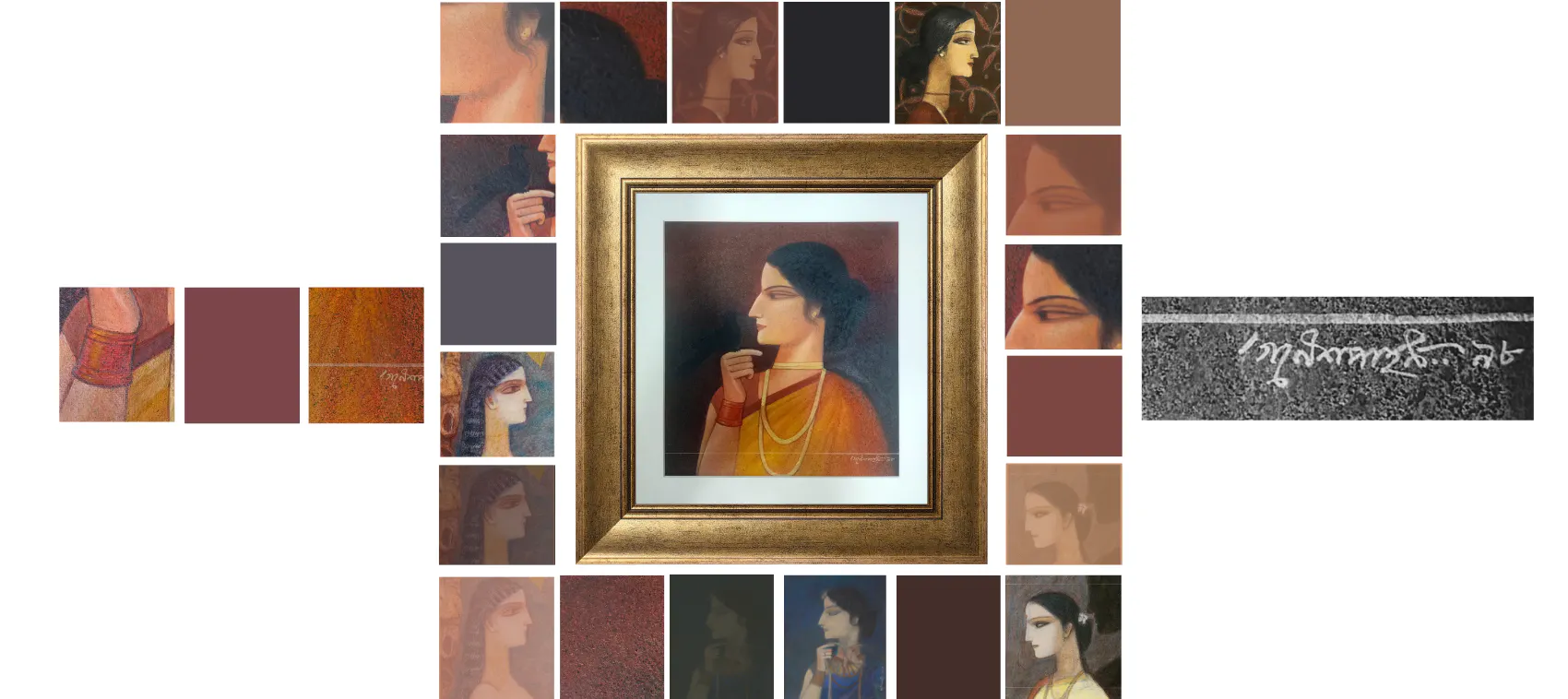
Pyne's Calcutta roots are embodied not only in his colours but also in his writing. He most often signed his works in Bengali. In this particular work, however, he has signed on verso in English.
Another unique feature of this work is the context from which it emerges.
"Ganesh Pyne is a quiet man, bespectacled, who speaks with reserve and an innate modesty. At the outset, it seems difficult to draw him out in conversation. Below the calm exterior, one senses the deep flow of thoughts, of emotions, of anguish. He sees too deep and too much, and what he sees is essentially chaos."
(‘Image and Imagination’, Geeti Sen, pg. 140)
Ganesh Pyne was a highly introverted, reclusive artist who mostly kept to himself. Pyne himself has remarked that he was a reserved person in general, and it is precisely this solitude in which he sought grounding for his works. Pyne was a deep thinker, visually evidenced in his jottings and diaries. He was constantly reflecting on his surroundings and his influences, recording quotations from philosophers such as Albert Camus.
With this in mind, the significance of the sketch & painting becomes noteworthy. It first features a pencil sketch of the painting, below which Pyne had inscribed a poem that reads: "In shadow deep, the lady poised; with grace, a bird in hand whispers of elegant grace." It is signed with love and dated 1998. This poem, written by Pyne for a dear friend captures in words the essence of the painting: the lady positioned in a calm and composed manner, set within the darkness he so often described. An original poem describing the painting, penned by the artist himself, instantly adds to the work's layered meaning.
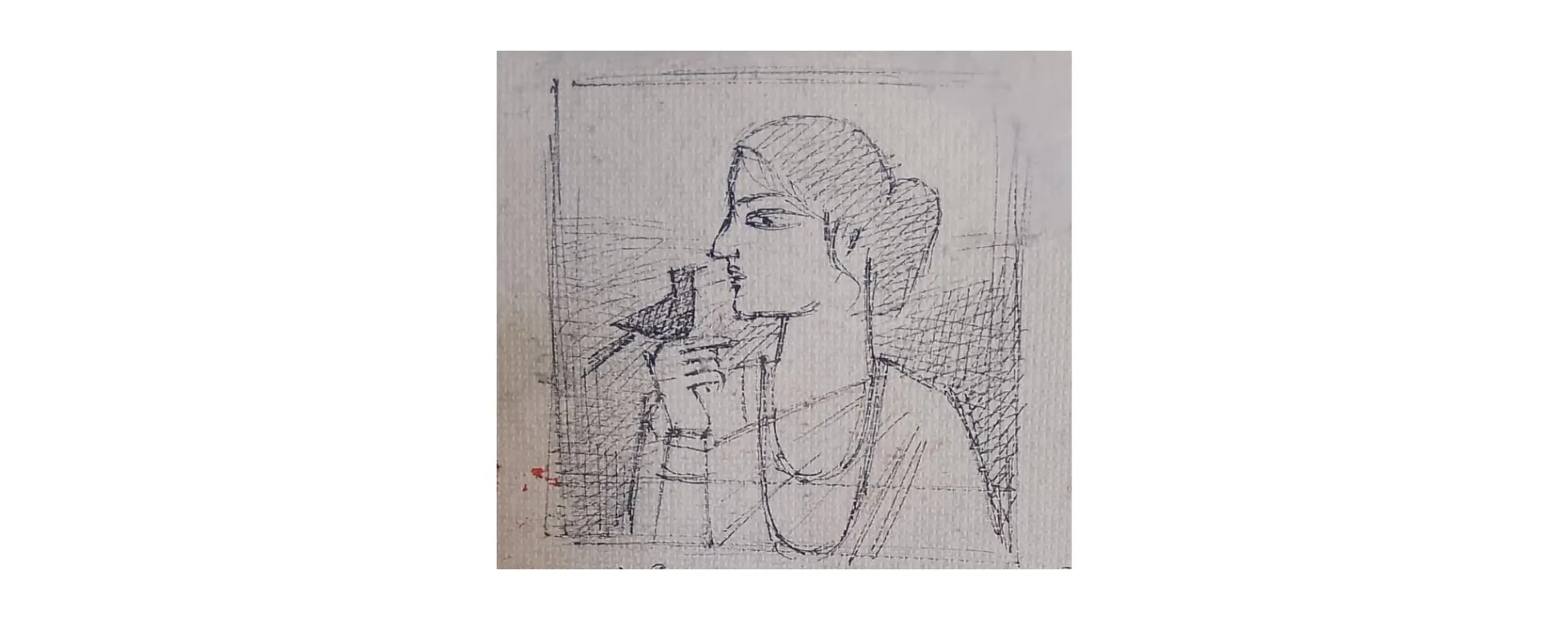
The poem is signed in the name of a dear friend, conveying love and affection; a particularly significant gesture given the artist's introverted and reserved nature. To have a deeply personal painting from Pyne, inscribed with a poem, is to gain access to a highly exclusive part of his life, one that was strictly kept hidden from public view. The poem is followed by two signatures of Ganesh Pyne, one in English and one in Bengali.
The painting is dated 1998, placing it at a particularly dynamic point in Pyne's life: that same year, he held his first major solo exhibition, titled ‘Ganesh Pyne: A Retrospective 1952- 1998’, at the CIMA, Kolkata. Prior to this, Pyne had participated in multiple group shows, and his solo presentations had consisted only of select displays of his jottings. That year therefore marked a landmark moment in Pyne's public life as an artist.
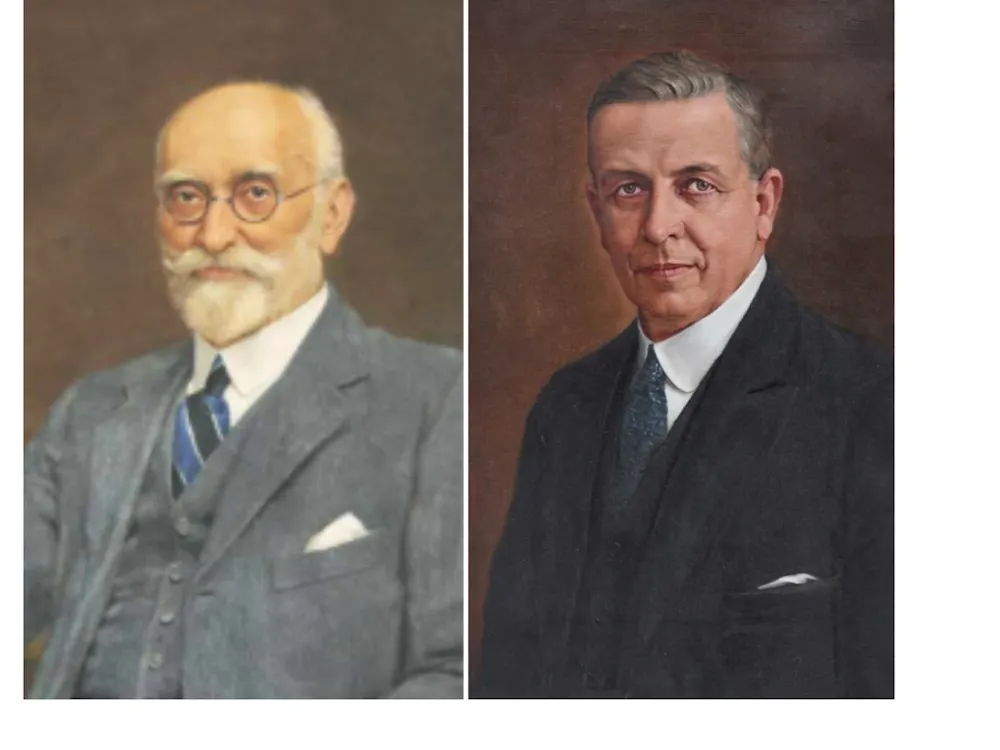
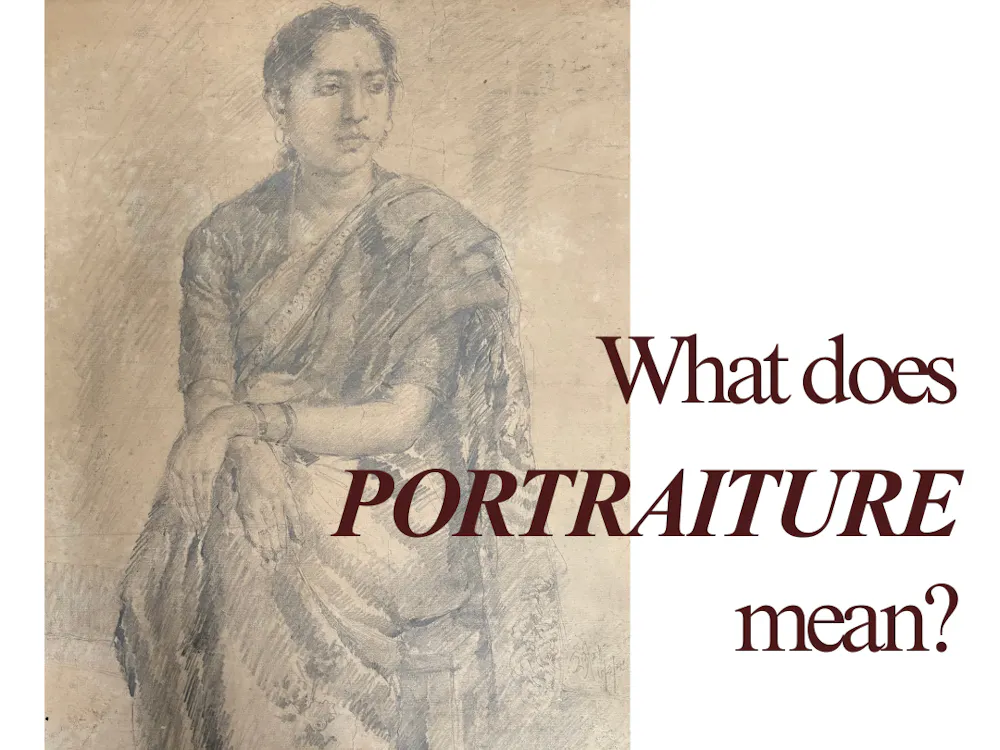
In order to deconstruct this painting, it must be situated within Pyne's larger oeuvre. In terms of stylistic composition, it would be most appropriate to compare this work to Pyne's other portraits. To begin with a broader view: for Pyne, portraiture meant capturing individual feeling, the essence of a single person's emotional turmoil. Most of his paintings feature solitary figures as can be seen from the representative illustration above. To arrive at a more nuanced understanding, we turn to Pyne's portraiture of women, which appears to be a recurring thread throughout his body of work.
Across his oeuvre, Pyne experimented with the feminine form through different mediums, including ink, watercolour, pastel, and most significantly in tempera. Over the years, he produced several notable portraits of women in the tempera medium, for instance the Portrait of a Woman (1991) and The Red Queen (1987) have been used for reference here.
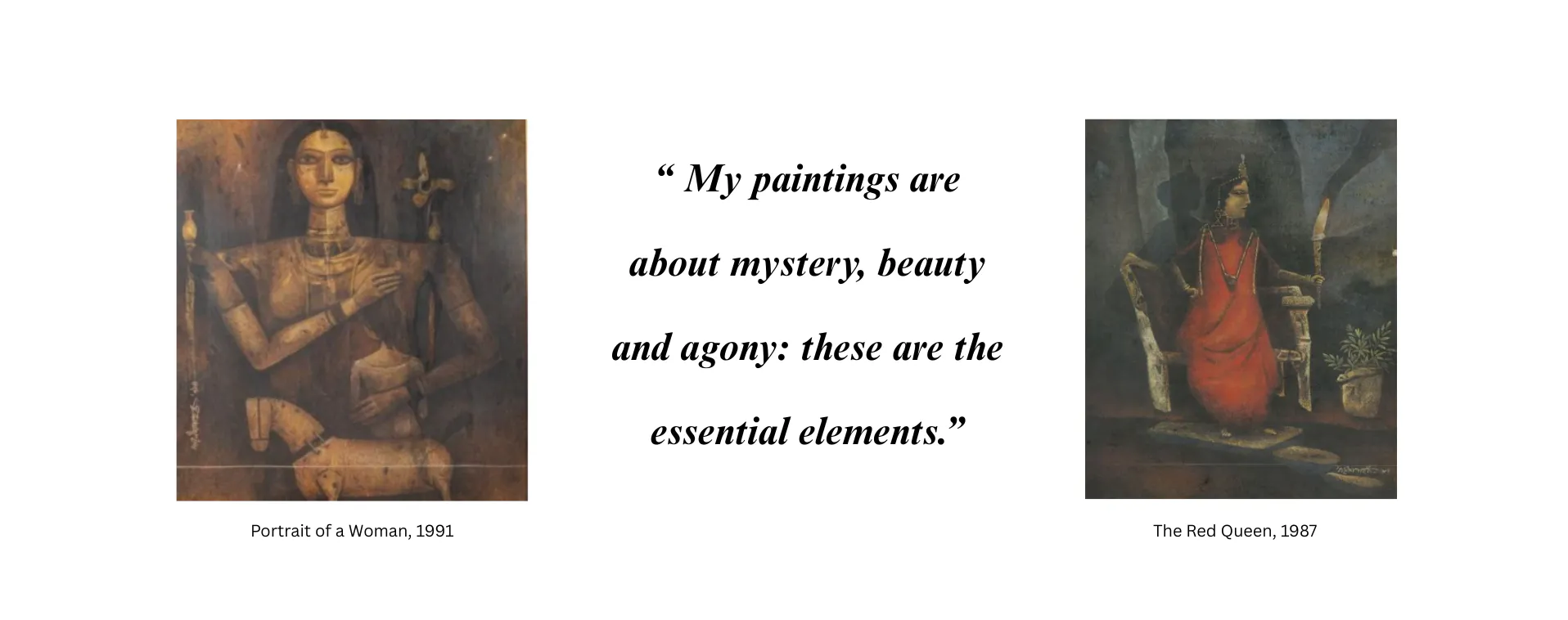
For the sake of analysis, it is worth noting here cruder versions of the paintings that are currently in public memory. The same side profile and comparable line of vision are used. The motif of a woman smelling or holding a flower recurs across Pyne's body of work, with multiple versions of the same subject observed across various mediums. It is worth noting that some of these paintings help illuminate Pyne's figurative structure more broadly: the woman is always angled to the side. Given the artist's preoccupation with darkness, it is reasonable to assume that the other half of the composition has been consumed by the great unknown.
Lot 9, in the Portraits & Figuratives auction can be closely compared to works in other mediums, such as Lot 30 (Bid & Hammer, December 2012) executed in Tempera and Gouache in 2009, (Figure and Flower, Bonhams, November 2016) executed in 1997 in pastels and Untitled, dated 2000 and executed in pastels displaying a long standing relationship between the artist and his muse. Another important observation is the crucial element of Nature in Pyne’s work. The women are not only shown holding a flower, but at times are positioned among trees, or even placed in dialogue with anthropomorphic figures.
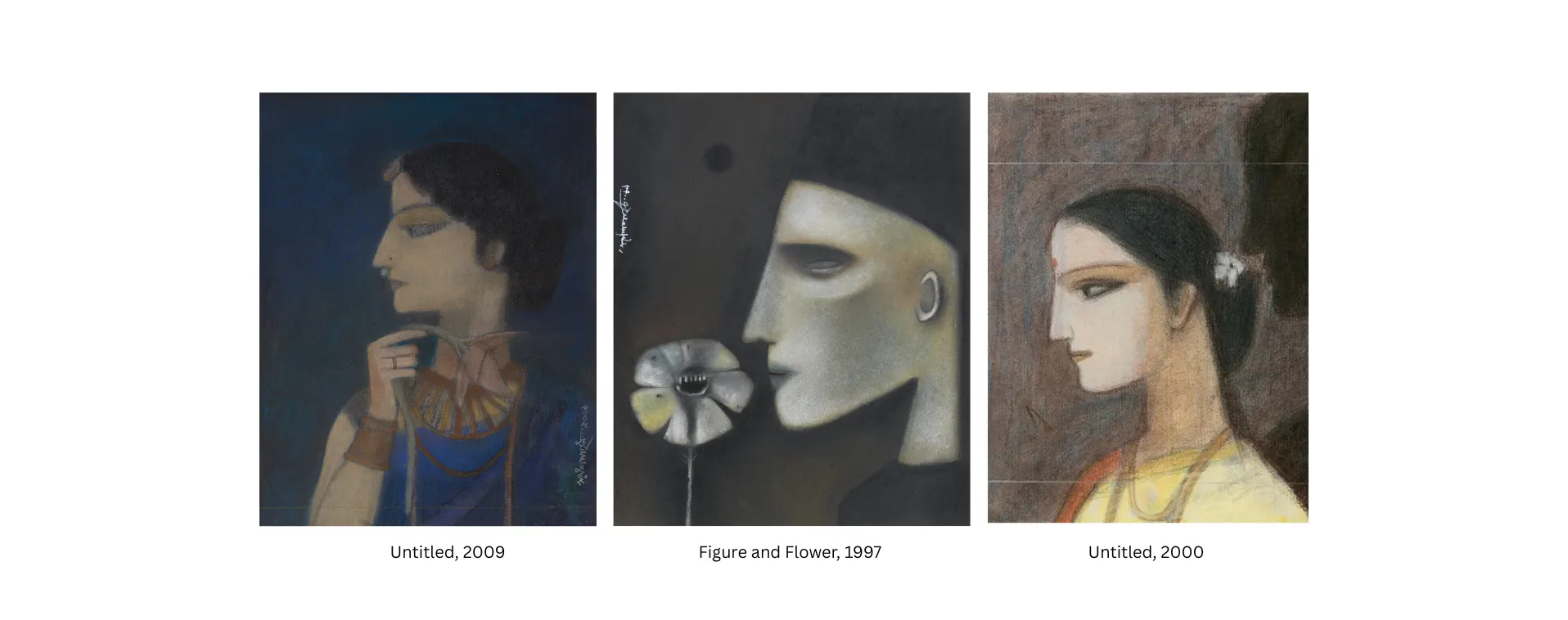
Ganesh Pyne himself remarked "Nature is so beautiful, it makes you feel sad. It also makes you feel elevated simultaneously. This is not a contradiction. It's like the crest and trough of a wave. The same wave, life and death, birth and rebirth,..." (‘The Flamed Mosaic’, pg 19)
In this painting, the focus on the bird is notable, as the artist appears to have deliberately withheld it from the viewer's immediate gaze. Even when one follows the woman's line of sight, the bird cannot be found there; one must pause deliberately on her hands to locate it.
This depiction of the Lady with a Bird stands out because of its size and format. Its rarity is further enhanced by the personal poetic note Pyne inscribed for his dear friend on its verso, and further enhanced by its journey through two important collectors who have cherished it with the same pride.
REGISTER TO KNOW ESTIMATES. Happy Bidding!
Related Links:
- A Melange of Portraits at Bid & Hammer’s Next, Republic Word, 20th July 2026
- The reticent modernist: Late artist Ganesh Pyne's work emerges as a favourite at auction houses, The New Indian Express, 28th November 2020