Looking Closely at Hemendranath Mazumdar’s First Sight
Born in 1894, in erstwhile East Bengal (present day Bangladesh), Hemendranath Mazumdar was a painter of exceptional talent. Praised for his fine treatment of pastels, watercolours and chalks, his real forte’ was in his handling of the medium of Oil painting. A renowned and thriving painter of the European academic style in the Kolkata of 1920s. In 1920, Mazumdar, along with some of his illustrious peers like Bhabani Charan Law, Jogesh Chandra Seal, Jamini Roy and Atul Bose founded the `Indian Academy of Art' at his own residence in Kolkata. (B & H, November 2010, Lot 28, Catalogue essay).
This painting is rare and exceptional within Mazumdar's body of work, both in subject and in composition. It stands apart from his popular series of women draped in wet sarees (Siktabasana), most often featuring solitary women, having finished daily activities like bathing or draping their garments.
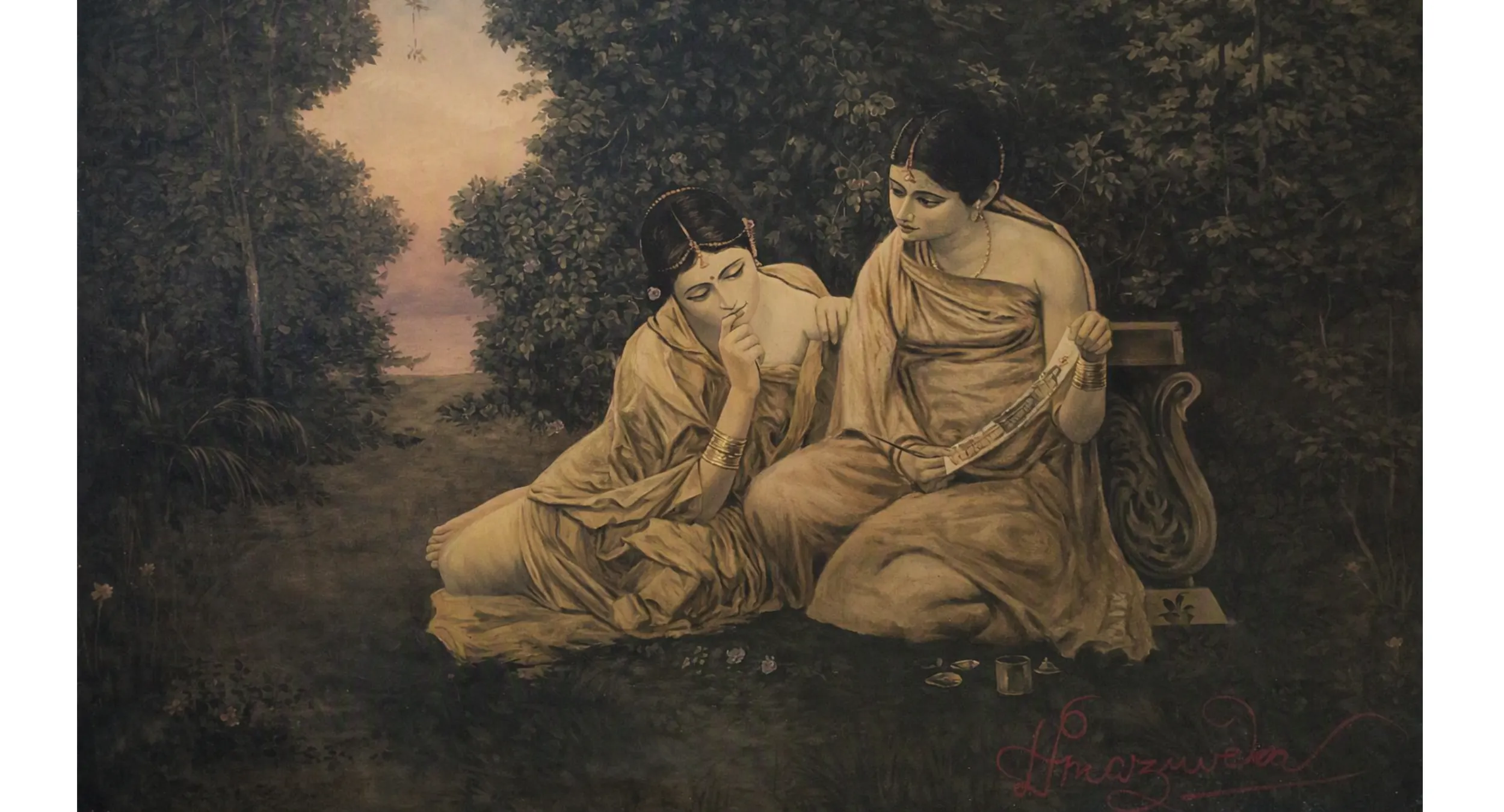
'First Sight' frames two young women at the centre of the viewer's gaze. The painting’s title in Bengali ‘আলেখ্য-দশন’ which translates to ‘Viewing the Painting’ addresses the main act depicted in it. The women sit casually, most likely in front of a stone bench in which one shows the other what appears to be her painting. The woman on the left peers intently at the scroll, her head resting on her hand, her lips pursed in thought. The work in front of her appears to be a painting made by the woman on the right. This is suggested by the materials lying near her knee, as though she has only just finished it. The woman on the right keeps her gaze fixed on her companion, waiting for a reaction with a paintbrush in her hand. This shared moment of trust and vulnerability is deftly rendered by the artist. Like the subjects of his other paintings, the two radiant women appear to belong to upper-class Bengal. The artist's red signature is prominent in the bottom right corner.
Both women are draped in fine, flowing sarees. Their fabric is bundled at the legs, crumpled around the arms, and shaped by the movement of their bodies. Hemendranath was best known for his studies of the human anatomy, and here he humanises his two subjects by capturing the natural flow of their bodies. The woman on the left leans forward to inspect her friend's painting, her back arched, her legs folded to the side, capturing her posture at ease. As she rests her hand on her friend’s back and the two lean into each other. The artist captures their organic, unguarded reactions. Hemendranath immortalises an anatomical conversation between two people caught in a shared moment. This sense of "presentness," rendered in Hemen's classic style, is what makes the painting so unique and so striking.
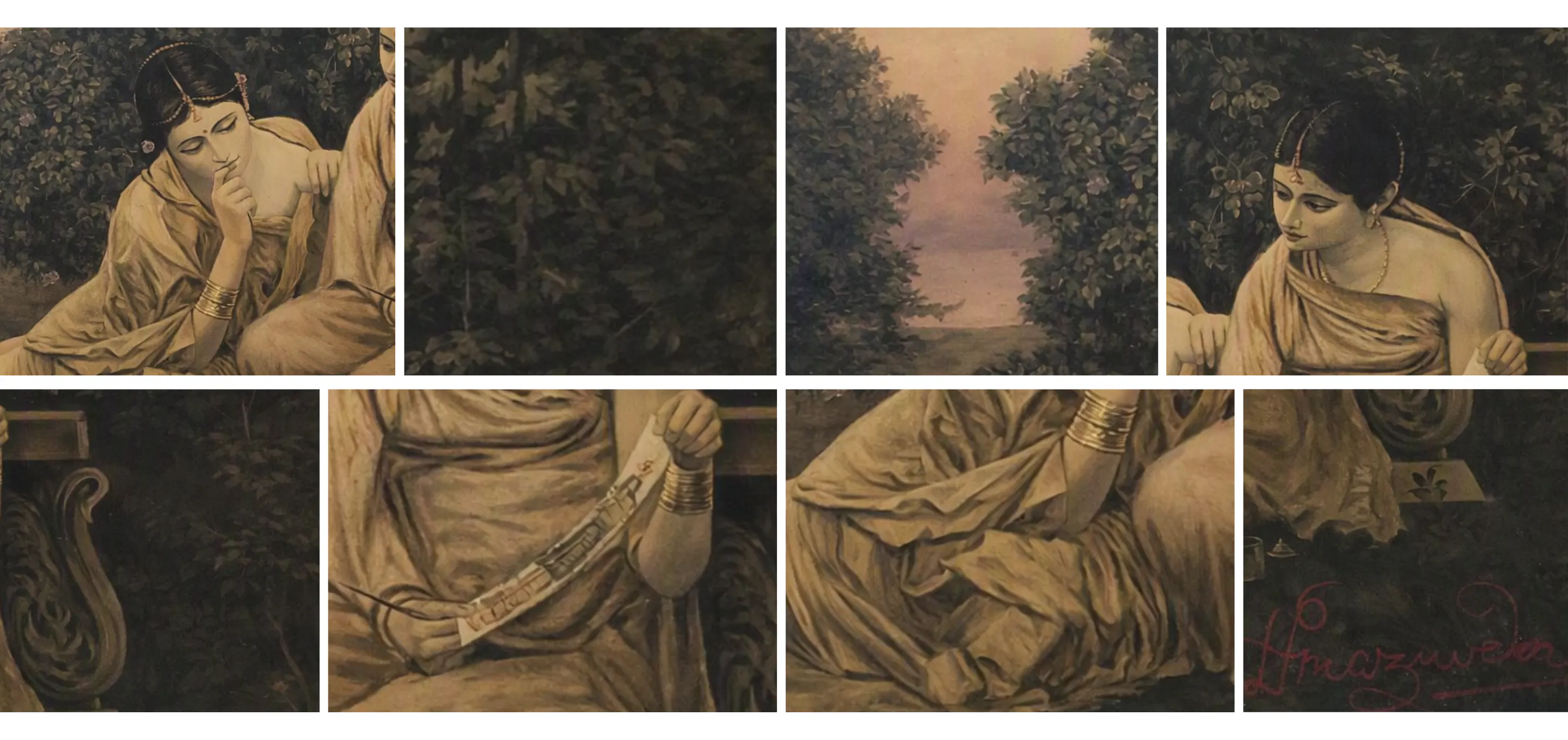
The painting sustains a tension between the permissible and the impermissible: the women appear approachable, yet their social standing places them out of reach for most of society. The dense vegetation surrounding them constructs this space as both secluded and free. Though placed at the centre of the composition, the women's gaze stays fixed on their own conversation. While the viewer watches their conversation unfold, they are kept away from the details. In 'First Sight,' Hemendranath Mazumdar simultaneously responds to two historical discourses by grounding their everyday lives in the ordinary and setting this against the forest as a space of stability and calm. The artist masterfully brings together interactions between body and space, between society and its structures.
What makes a painting by Hemendranath Mazumdar distinctive is the fact that the artist himself produced multiple versions of his work. It is well documented that Mazumdar produced several versions of his paintings. This repetition was rarely incidental. It reflected a deliberate choice made by artist and shaped by his patrons.
Over the course of his career, Mazumdar spent several years working as a court painter across the courts of the Maharajas of Kashmir, Patiala, Bikaner, Jaipur, Jodhpur and Dholpur. These rulers would often request variations of his compositions, each wanting to own the painting for themselves. Beyond the courts, nobles and wealthy zamindars were also regular patrons of the artist. Mazumdar spent extended periods living in Bengali zamindari households, particularly in the Bandarhati region, where he stayed for several years at the Bandarhati Thakurbadi and was commissioned to produce paintings for the family. This detail is central to understanding the present painting.
The Thakurbadi, though prosperous, did not command the same resources as the royal courts. As a result, the artist worked with materials sourced locally, and this is reflected in the choice of canvas and pigments seen here. It is likely that the relatively delicate quality of this particular canvas owes to the more limited materials available in the region. In that sense, this painting is far more delicate and unique than its counterparts, making it more intimate and personal.
While there are multiple versions of ‘First Sight' that are currently publicly documented, refence is made here to one version published with the same title as Plate 2 in “The Art of Mr H Mazumdar” Volume III published by Indian Academy of Art, edited by P. Shome & C.P. Ray, c.1920-1924.
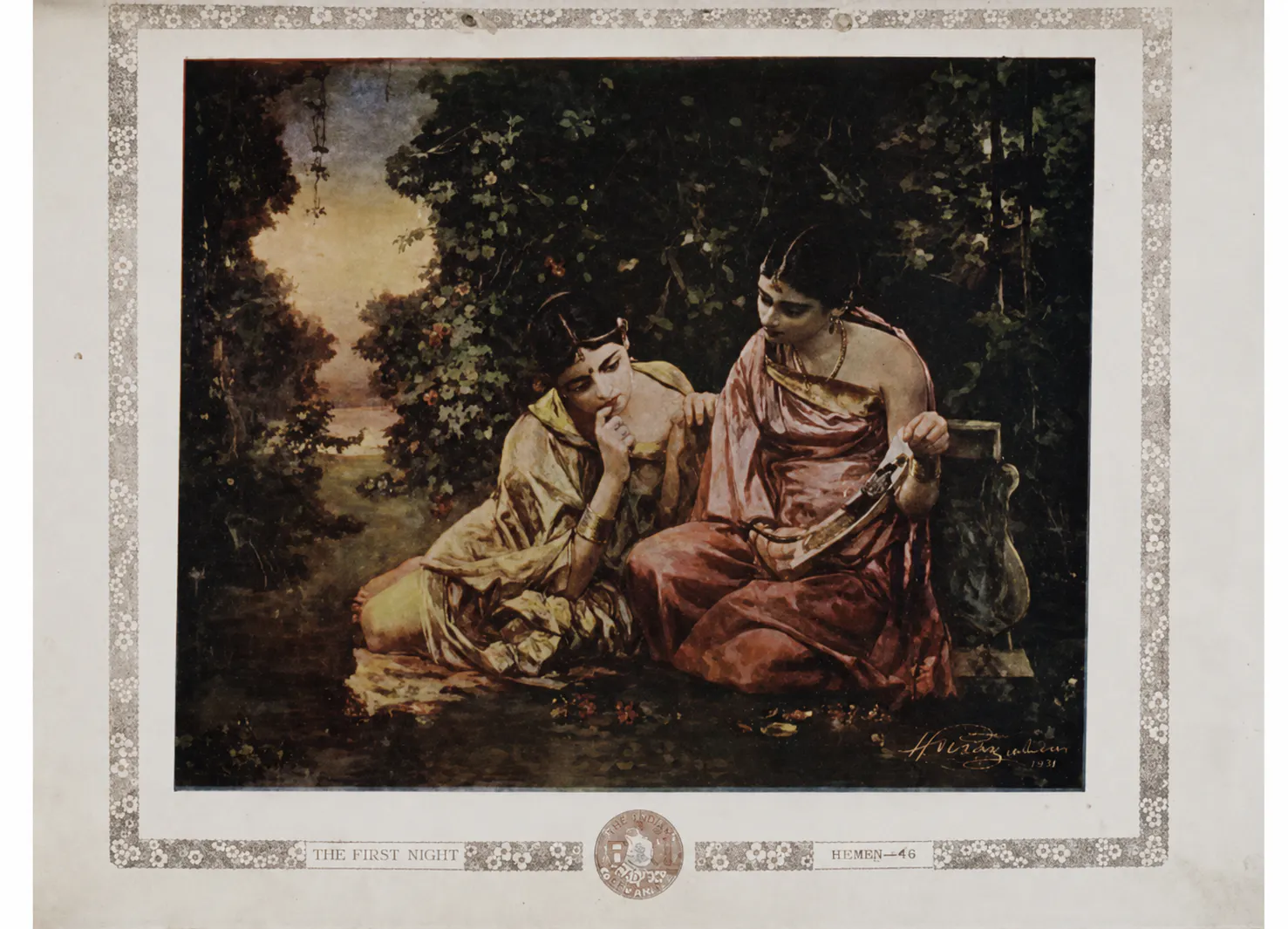
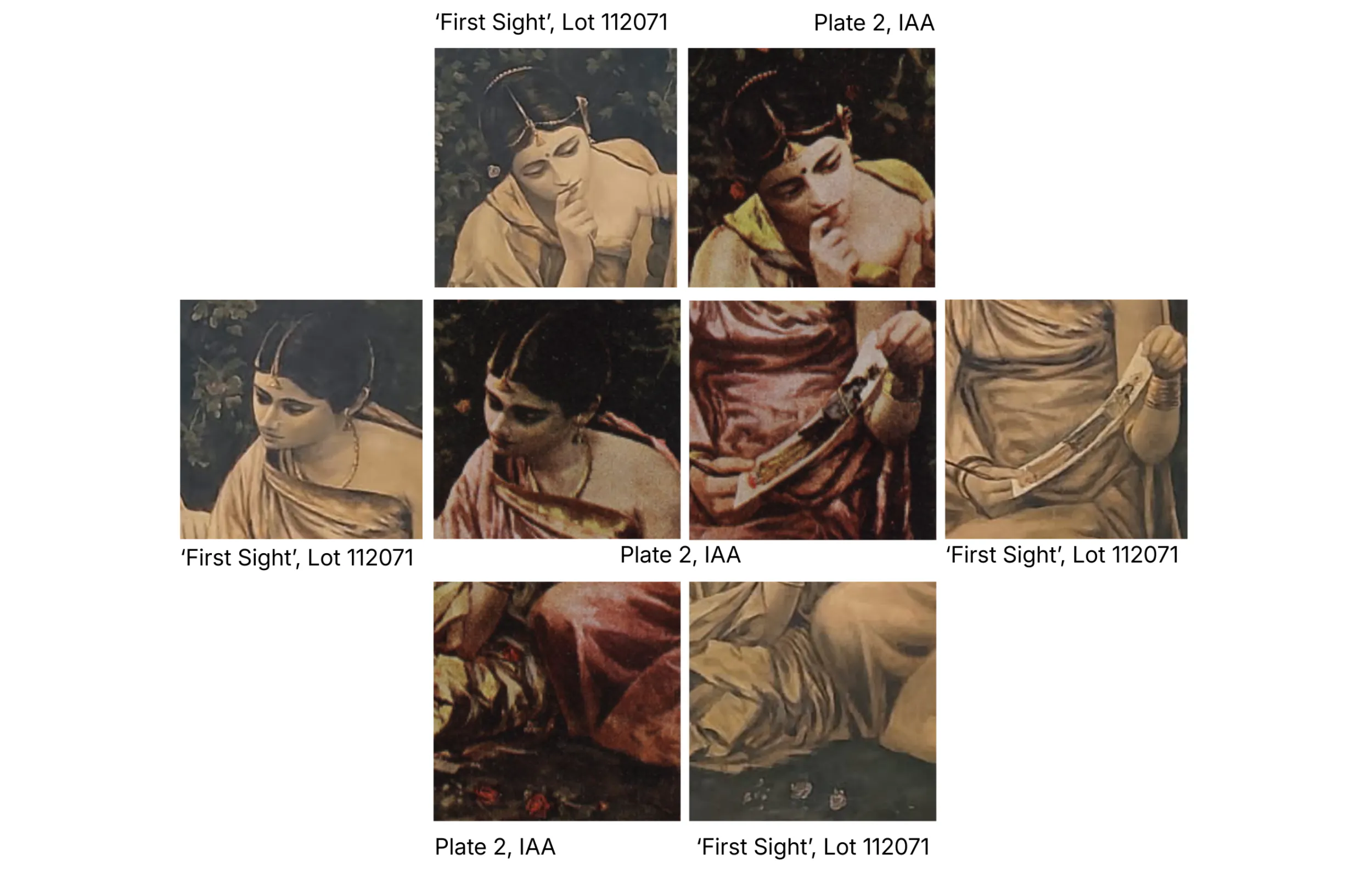
Set side by side, the two paintings reveal striking similarities. The core composition is unchanged across versions: the two women are placed at the centre of the frame, dense foliage surrounds them on all sides, and both are engrossed in the same shared activity. It is evident that the artist paid close attention to detail and worked carefully to carry this composition faithfully from one version to the next.
Yet, despite being unmistakably from the same hand, the two versions diverge in several telling ways. The shape of the women's faces differs. In the canvas at hand, the features are sharper and more defined, while in the printed plate version, both women have noticeably rounder faces. The colouring of their garments differs too. The plate renders the sarees in mauve and pale beige tones, with visible contrast between the two women's dress. On the other hand, this canvas at hand is worked almost entirely in subtle grey and beige undertones, with far less tonal distinction between the two figures.
The landscape shows the most pronounced differences, both in composition and in level of detail. The plate version opens onto a visible clearing in the middle distance, and a warmer, more exposed dusk sky. The canvas at hand, by contrast, keeps the enclosure described earlier far tighter, with individual leaves, branches and their interplay of light and shadow worked in real detail. This level of intricacy is noticeably toned down, and rendered denser in colour, in the plate version. The landscape reveals the same tonal contrast: the plate favours rich, saturated colour over fine detail, while the canvas trades that colour for tonally subtler, more intricate plays of light and shadow.
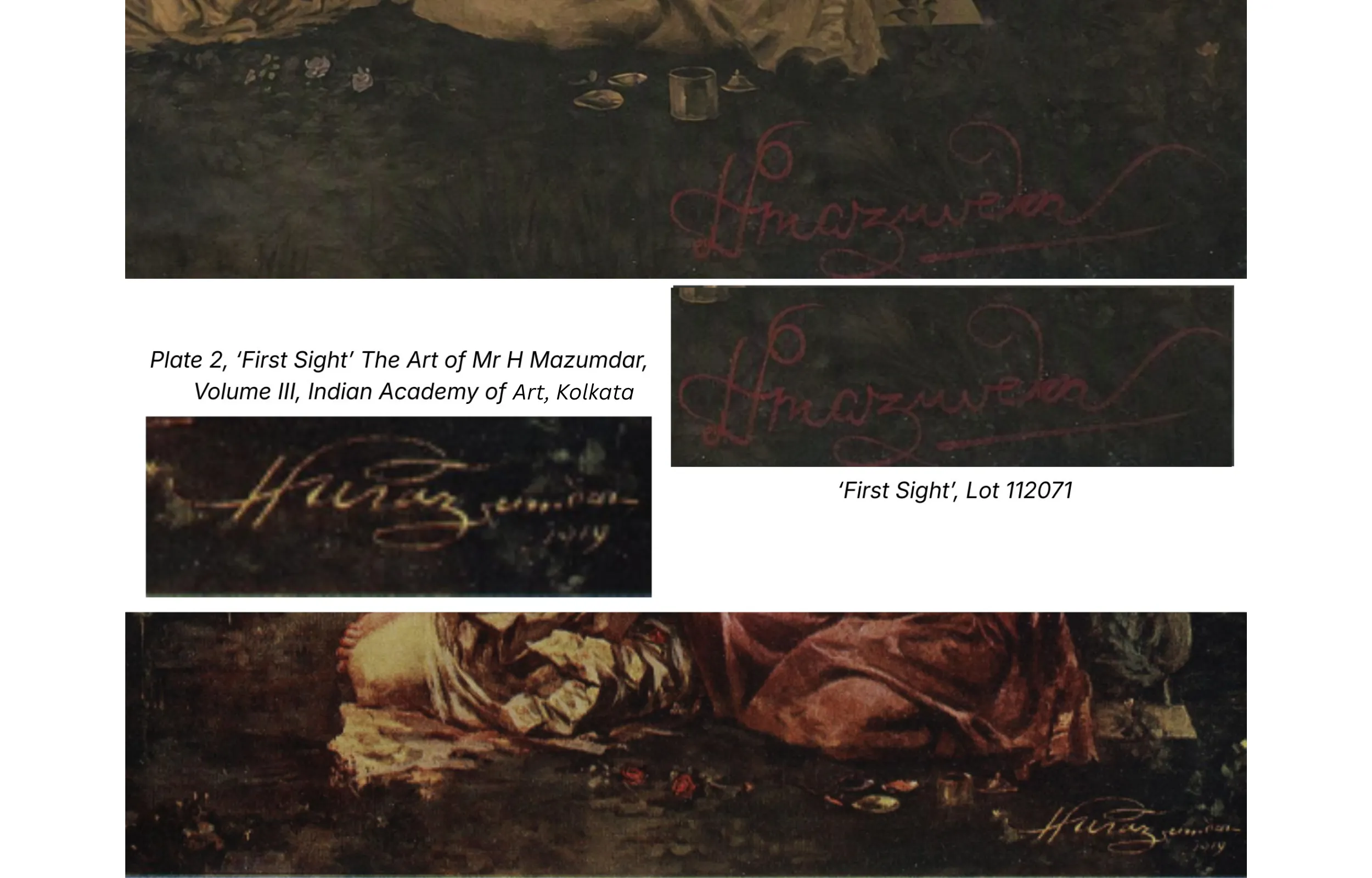
The most significant difference, however, lies in the signatures. This version carries a typical Hemendranath Mazumdar signature in red, bold and cursive. The artist appears not merely to mark his work but to assert real pride and confidence in it. The plate version, by contrast, bears a signature in white, considerably smaller in scale and dated 1914. Occupying far less space on the canvas, this white signature reads as more reserved and sophisticated. The two also differ in handwriting: one rendered in a looser, more cursive hand, the other sharper and more controlled. The white signature is dated, giving us a small but telling detail that may help place the two versions at different points in the artist's career. The canvas at hand appears to be of a later date. In Hemendranath Mazumdar’s later career he appears to give more importance to light and shadow as opposed to tonality of the colours, similar to the work at present.
'First Sight' is, in every sense, an outlier in Hemendranath Mazumdar's oeuvre. An intimate study of friendship, trust and quiet rebellion, staged in a forest of extraordinary botanical detail. This work shows the fuller range of his ambition. It captures his command of the human form, his sensitivity to texture, and his willingness to place women outside the household and let them simply exist with one another.
This is a painting that must be seen closely to be felt deeply.
To acquire this painting, Enquire Now
Video Link: Looking Closely, A Bid & Hammer PTS Exclusive